
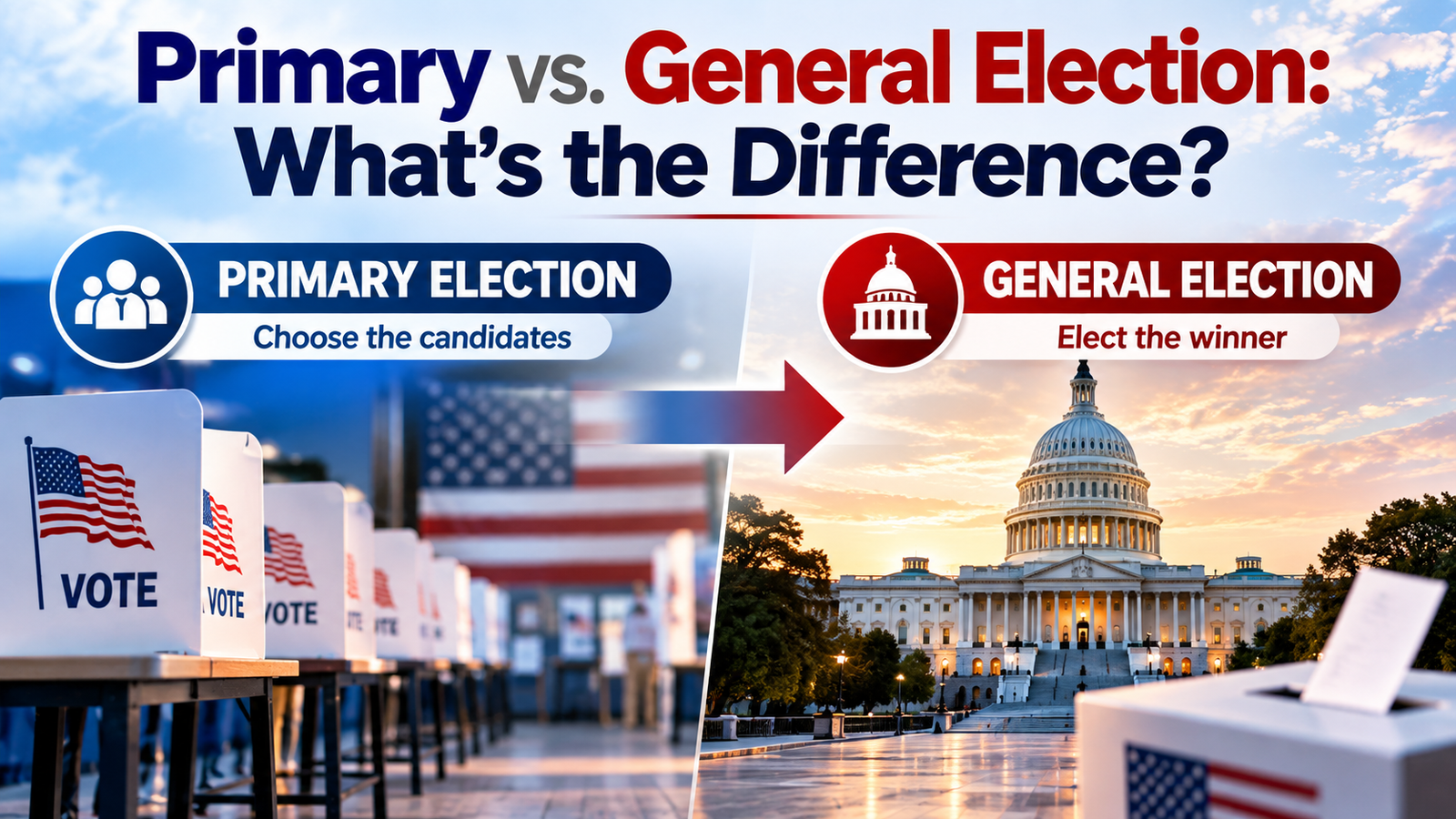
In the United States, candidates for many elected offices may face voters at more than one stage of the election process. A primary election generally determines who will represent a political party—or which candidates will advance—while a general election determines who will hold the office.
The distinction sounds simple, but U.S. primary systems vary considerably. States use different rules, political parties sometimes play a role in setting those rules, and some states use systems that do not operate like traditional party primaries.
This guide explains the difference between primary and general elections and where the major exceptions fit.
The Short Answer
A primary election is generally about nomination or advancement. It narrows the field of candidates before the general election.
A general election is generally about electing someone to office.
In a traditional partisan primary, voters help determine which candidate will represent a political party in the general election. In some nonpartisan or multi-candidate systems, however, a primary simply determines which candidates advance rather than selecting a party nominee.
The exact rules depend on the state, office and, in some cases, political party. The U.S. Election Assistance Commission (EAC) emphasizes that primary-election procedures vary by state.
What Is a Primary Election?
A primary election takes place before the general election and is used to narrow the field of candidates.
In traditional partisan elections, primaries are used to select which candidates will represent political parties in the general election. Nonpartisan primaries can instead be used to reduce a larger field to a smaller number of candidates.
Winning a primary therefore usually does not mean that a candidate has won the office. It normally means the candidate has won a party nomination or has qualified to advance to another stage of the election.
Most primaries are administered by state and local election officials, although political parties may administer primaries in some circumstances.
What Is a General Election?
The general election is the stage at which voters choose who will hold an elected office.
For federal elections, Election Day occurs on the Tuesday after the first Monday in November. In 2026, Election Day is Tuesday, November 3.
Unlike primary participation, voting in a general election is not restricted by a voter’s party registration. A voter is not required to support the candidate of the party with which they may be registered. USAGov also confirms that a person can vote in a general election even if they did not participate in the preceding primary.
For presidential elections specifically, the general-election ballot can include major-party nominees as well as qualifying minor-party and independent candidates.
Nomination vs. Election to Office
This is the central distinction between the two elections:
Primary election → Who advances?
General election → Who wins the office?
In a traditional partisan system, a candidate who wins a primary becomes the party’s nominee but must still compete in the general election.
For example, congressional candidates may first compete for their party’s nomination. The successful nominees then compete in the general election for the congressional seat.
Not every election follows this exact model. Some states use systems in which all candidates appear together in a primary and the highest finishers advance regardless of party.
Where Primaries Fit in the Election Cycle
A typical election cycle can be simplified into four stages:
Candidates qualify → Primary or other nominating process → General election → Winner takes office
The details vary.
Some candidates participate in party primaries. Presidential candidates compete through a combination of primaries and caucuses for convention delegates. Some offices use nonpartisan primaries, while some candidates may reach a general-election ballot through other ballot-access procedures.
Primary dates also vary considerably by state and office.
For presidential elections, USAGov says most states hold presidential primaries roughly six to nine months before the presidential election.
For a broader explanation of the presidential process, see How U.S. Presidential Elections Work: A Step-by-Step Guide.
For congressional election cycles, see Midterm Elections Explained: How House and Senate Elections Work.
Open, Closed and Other Types of Primaries
One reason primary elections can be confusing is that the United States does not use a single nationwide primary system.
The EAC groups primary systems into several broad categories and cautions that rules differ among states and jurisdictions.
Closed Primaries
In a closed primary, participation is generally limited to voters affiliated with the political party holding the primary.
A voter participating in that primary receives a ballot containing candidates seeking that party’s nomination.
Open Primaries
In an open primary, voters generally do not have to be registered with a particular political party to participate in that party’s primary.
The details still vary. Some states require voters to select a party ballot publicly at the polling place, while others allow the choice to be made privately.
Partially Open and Partially Closed Primaries
Some states use systems between the traditional open and closed models.
For example, unaffiliated voters may be permitted to participate while voters registered with another party may not be. In other systems, political parties may have some authority to determine who can participate.
Terms such as semi-open, semi-closed, partially open and partially closed are not used identically everywhere. The important point is that voters should check the rules that apply in their state rather than assuming one definition applies nationwide.
What Are Top-Two and Other Multi-Candidate Primaries?
Some states use systems that differ substantially from traditional party-nominating primaries.
California provides a clear example.
For California’s voter-nominated offices, candidates appear together on the same primary ballot. Voters may choose any candidate regardless of party preference, and the two candidates receiving the most votes advance to the general election, even if both identify with the same party preference.
California also makes an important distinction: candidates advancing under this system are not considered the official nominees of the political parties whose preferences they list.
The system does not apply to California’s presidential primary.
Other states use their own variations, including systems in which more than two candidates can advance. This is another reason that “primary election” does not describe one uniform process nationwide.
Presidential Primaries Are Different
Presidential nomination contests require an additional distinction.
In a presidential primary, voters help determine the allocation or selection of delegates who participate in the political party’s national convention. The EAC describes presidential-primary voters as generally voting for party delegates rather than directly electing the presidential nominee.
States and parties can also use caucuses. Unlike ordinary government-administered elections, caucuses are meetings run by political parties.
Rules for awarding presidential delegates vary by state and are established through political-party rules at the national and state levels.
Those delegates later participate in national party conventions. A presidential candidate typically needs a majority of the party’s delegates to secure the nomination.
This means a presidential primary should not be treated as identical to a congressional or state-office primary.
What Happens After Someone Wins a Primary?
In a traditional partisan primary, the successful candidate normally advances to the general election as the party’s nominee.
In a nonpartisan or multi-candidate system, winning or placing high enough in the primary may instead mean advancing to the next election without becoming a party nominee.
Presidential contests are different again because primary and caucus results determine delegates, with the presidential nomination process culminating at the national party convention.
What Happens in the General Election?
The general election determines who will hold the office.
Eligible voters can participate regardless of whether they voted in the primary. They are also not required to vote for candidates from the political party with which they are registered.
Exactly which candidates appear on a general-election ballot depends on the office and applicable ballot-access rules.
Those rules matter because not every candidate appearing in a general election necessarily reached the ballot by winning a traditional party primary.
Do Independent and Minor-Party Candidates Always Enter Primaries?
No single rule applies to every office and state.
Ballot-access procedures for independent and minor-party candidates vary, so a candidate does not necessarily have to win a traditional major-party primary to appear in a general election.
For presidential elections, for example, USAGov notes that qualifying minor-party and independent candidates may appear on state ballots if they satisfy applicable requirements, which can include petition-signature requirements.
Requirements for congressional, state and local offices can differ. Voters and candidates should therefore consult the appropriate state or local election authority for the rules governing a particular contest.
What Is a Runoff Election?
A runoff is an additional election that may be required when no candidate satisfies the threshold necessary to win or advance under the applicable election rules.
Whether a runoff occurs—and what threshold triggers one—depends on state law and the type of election.
Runoffs can occur after primaries in some states and after general elections in certain circumstances.
They should therefore be viewed as another possible stage in the election process rather than as a feature of every U.S. election.
Why Do Primary Rules Differ by State?
Election administration in the United States is highly decentralized.
For congressional elections, the Constitution’s Elections Clause gives state legislatures authority over the “Times, Places and Manner” of elections, while giving Congress authority to make or alter such regulations. The Constitution Annotated also discusses Supreme Court precedent recognizing state authority concerning primary elections.
States have consequently developed different systems for conducting elections.
Political parties also play a particularly important role in presidential nominations, including rules governing delegates and caucuses.
The result is that two voters living in different states may encounter substantially different primary-election procedures.
For current rules, voters should check with their state or local election authority.
Primary vs. General Election at a Glance
| Primary Election | General Election | |
|---|---|---|
| Main purpose | Select a party nominee or determine who advances | Determine who wins the office |
| Candidates | Candidates seeking nomination or advancement | Candidates who qualified for the general-election ballot |
| Who can vote | Depends on state, office and sometimes party rules | Eligible voters regardless of party affiliation |
| Typical result | Nomination or advancement | Election to office |
| Timing | Varies by state and office | Federal elections occur in November |
| Does the winner take office? | Usually not | Generally yes, subject to applicable runoff or other rules |
Key Takeaway
The simplest distinction is:
A primary election generally determines who advances. A general election generally determines who wins the office.
Traditional partisan primaries select party nominees, but that is not the only system used in the United States. Primary rules can be open, closed or somewhere in between, while some states use multi-candidate systems in which candidates advance regardless of party.
Presidential primaries add another layer because voters participate in a delegate-based nomination process that ultimately leads to national party conventions.
Because these rules vary, the safest way to understand a particular primary is to check the election authority for the state and office involved.
Sources
- U.S. Election Assistance Commission — Primary Election Types
- U.S. Election Assistance Commission — Presidential Elections
- USAGov — Presidential Primaries and Caucuses
- USAGov — National Conventions
- USAGov — Presidential General Election
- USAGov — Do You Have to Vote for the Party You Are Registered With?
- Constitution Annotated — States and the Elections Clause
- California Secretary of State — Voter-Nominated Offices Information
- California Secretary of State — 2026 Primary Election Official Voter Information Guide
Election-related information last reviewed September 2026. The American Elections is an independent educational resource and is not affiliated with any campaign, political party, or election authority.