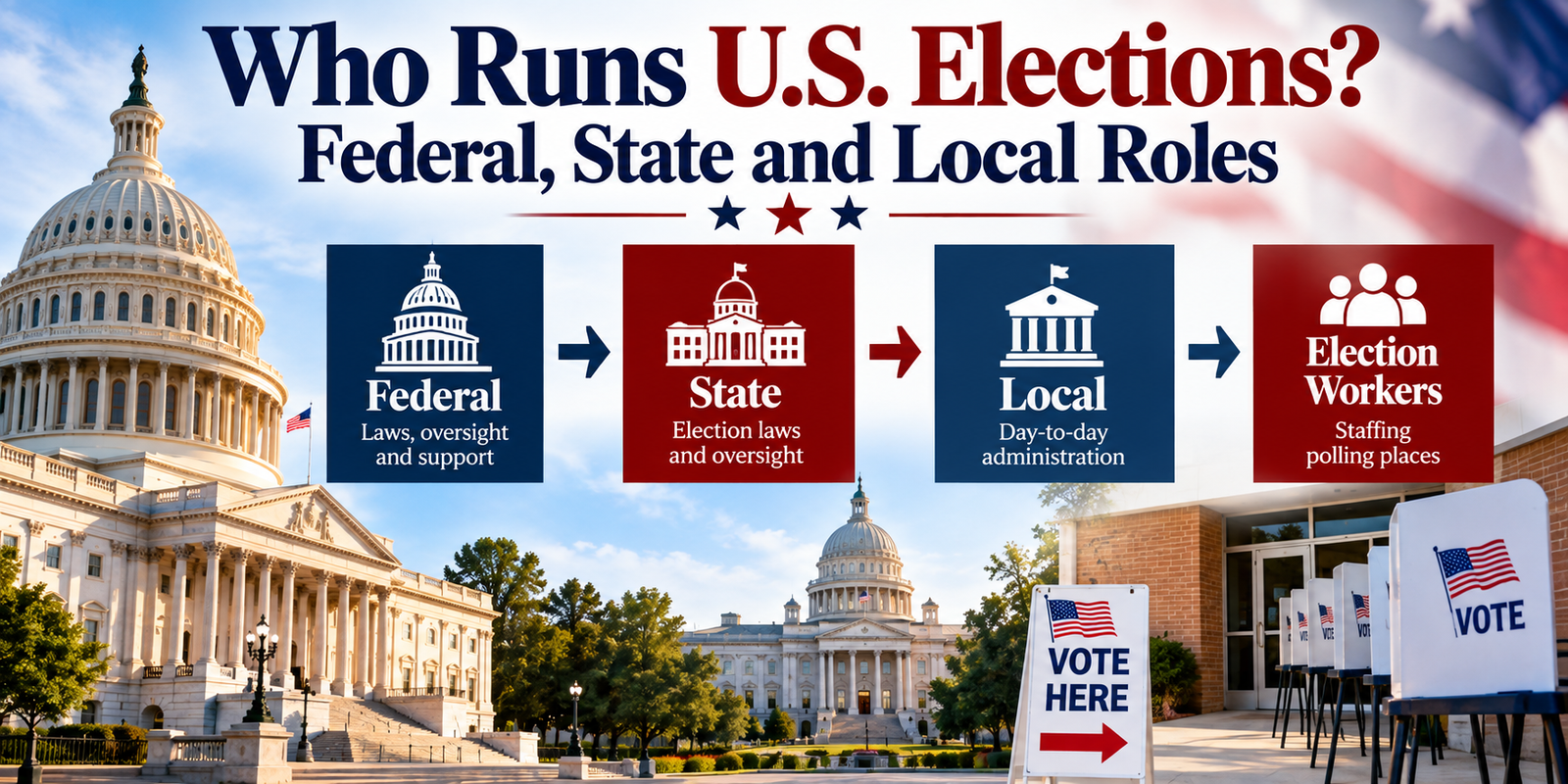
There is no single national authority that runs elections in the United States. Instead, election administration is decentralized across state and local governments operating within requirements established by the Constitution, federal law and state law.
The U.S. Election Assistance Commission (EAC) says the country has more than 10,000 election jurisdictions. Elections are usually administered at the county level, although cities or townships administer them in some states, and the structure varies substantially from one state to another.
Federal agencies also have important responsibilities. But the agency that regulates campaign finance is not the agency that helps develop voting-system standards, and neither is the office that normally counts a voter’s ballot.
Understanding those distinctions makes the U.S. election system much easier to follow.
Who Is Responsible for U.S. Elections?
Responsibility is divided among federal, state and local institutions.
For congressional elections, the Constitution’s Elections Clause gives state legislatures authority to prescribe the times, places and manner of elections for senators and representatives, while allowing Congress to make or alter those regulations, subject to the constitutional exception concerning the places of choosing senators.
For presidential elections, the Constitution provides that each state appoints electors in the manner directed by its legislature.
Federal laws add nationwide requirements covering areas such as voting rights, voter registration, military and overseas voting and minimum election-administration standards.
But the actual administration of elections remains primarily a state and local function. The Federal Election Commission itself explains that elections are primarily governed by state law and administered at state and local levels.
The Federal Government’s Role
The federal government influences election administration in several different ways.
Congress
Congress has constitutional authority over aspects of federal elections and has enacted laws addressing voting rights, voter registration, military and overseas voting, election administration and campaign finance.
It also created the U.S. Election Assistance Commission through the Help America Vote Act of 2002, commonly called HAVA.
Congress does not, however, function as a national election-administration office that operates polling places or tabulates ordinary election results.
U.S. Election Assistance Commission
The Election Assistance Commission (EAC) was established by HAVA.
Among its responsibilities, the EAC:
- distributes certain HAVA funds;
- develops voting-system guidelines;
- operates a federal voting-system testing and certification program;
- maintains the National Mail Voter Registration Form;
- conducts election-administration research; and
- serves as a national clearinghouse for election-administration information.
An important distinction concerns voting-system standards.
The EAC’s Voluntary Voting System Guidelines (VVSG) provide specifications against which voting systems can be tested. As the name indicates, these guidelines are not automatically mandatory nationwide.
The EAC states that following the VVSG is voluntary except in states where state law requires compliance. States also are not federally required to participate in the EAC’s voting-system certification program.
HAVA itself is different: the federal statute establishes certain minimum requirements that states must follow in federal elections.
The EAC does not certify election winners.
What Does the Federal Election Commission Do?
The name Federal Election Commission (FEC) can cause confusion.
The FEC regulates federal campaign finance. Its responsibilities include campaign-finance disclosure, contribution and expenditure rules and administration of the presidential public-funding program.
It does not administer voting.
The FEC explicitly states that it has no jurisdiction over laws concerning voting, voter fraud and intimidation, election results or the Electoral College. State election offices are responsible for certifying election results under the applicable processes.
In simple terms:
FEC = campaign finance, not vote counting.
What Does the Department of Justice Do?
The U.S. Department of Justice has an enforcement role.
Its Civil Rights Division includes a Voting Section that enforces the civil provisions of federal laws protecting voting rights. These include the Voting Rights Act, National Voter Registration Act, Uniformed and Overseas Citizens Absentee Voting Act and Help America Vote Act.
The Justice Department can also monitor polling locations in particular circumstances and accepts complaints concerning potential violations of federal voting-rights laws.
That does not make DOJ the administrator of elections. Its role is primarily one of federal-law enforcement.
What Does CISA Do?
The Cybersecurity and Infrastructure Security Agency (CISA), part of the Department of Homeland Security, supports election-infrastructure security.
Election infrastructure includes systems and facilities such as voting systems, voter-registration databases, systems used to report results and polling places.
CISA works with state and local election officials and other election-infrastructure partners. Its current election-security resources include voluntary, no-cost services intended to help election officials strengthen cybersecurity and resilience.
CISA can therefore help election officials protect election infrastructure.
It does not count ballots or certify election winners.
What State Governments Do
States have major responsibility for determining how elections operate.
Within constitutional and federal-law requirements, state law governs many issues including:
- voter-registration procedures;
- ballot access;
- early voting;
- mail voting;
- voter-identification requirements;
- voting methods;
- recount procedures;
- election audits; and
- certification procedures.
Each state has a chief election official, but the administrative structure is not identical nationwide.
A secretary of state performs this role in some states. Other states use boards, commissions or different officials, and responsibilities may be divided among multiple institutions.
States also decide how to use federal voting-system standards. A state can, for example, require voting equipment to comply with EAC certification even though federal law does not require every state to participate in that program.
What Local Election Officials Do
Much of the work voters actually see occurs locally.
Depending on the state, elections may be administered by counties, cities, townships or combinations of state and local authorities.
Officials may have titles such as:
- county clerk;
- registrar;
- supervisor of elections;
- county auditor;
- municipal clerk;
- election director; or
- board of elections.
Their exact responsibilities vary, but common duties can include maintaining voter-registration records, preparing ballots, operating polling locations, recruiting poll workers, processing mail ballots, testing equipment, conducting early voting, tabulating ballots and participating in canvassing and certification.
The variation is substantial enough that EAC cautions that no two states administer elections in exactly the same way.
What Poll Workers Do
Poll workers are generally recruited and managed by election authorities to assist voters at polling locations.
Depending on the jurisdiction, they may be called election judges, inspectors, clerks or other titles.
Typical responsibilities include preparing the polling location, checking voters in, issuing ballots and helping voters use voting equipment.
Eligibility requirements and staffing rules differ by state. Some jurisdictions have requirements concerning political-party representation among poll workers, while others use different systems.
For that reason, there is no single nationwide poll-worker model.
Who Counts the Votes?
There is no single federal vote-counting center for U.S. elections.
State and local election officials count and tabulate ballots under procedures established by applicable law.
Although the details vary, the process generally moves through several stages:
Ballots cast → tabulation → unofficial results → canvass → audits where required → certification
The canvass is an important part of this process. Election officials reconcile election data and ensure that valid ballots—including applicable mail, provisional, military and overseas ballots—are incorporated into the results.
Election-night totals are unofficial.
The EAC specifically notes that results remain unofficial even when reporting shows “100% Precincts Reporting.” Media organizations may project winners, but those projections are not official election certifications.
Who Certifies Election Results?
Certification is the formal process through which election officials attest to the final election results.
There is no single national certification procedure for every election.
The official or body responsible can vary by state, locality and type of contest. Local certification may involve an election board, county official or municipal official. State certification may involve a secretary of state, governor, election board, election director or another body designated by state law.
The EAC confirms that certification structures and schedules vary among states and, in some cases, among local jurisdictions within the same state.
The FEC, EAC and CISA do not certify ordinary election winners.
Presidential Elections Have Additional Steps
Presidential elections include additional constitutional and statutory procedures involving presidential electors.
After the general election, each state prepares a Certificate of Ascertainment identifying the appointed electors. Current federal law requires the state’s executive to issue the certificate no later than six days before the electors meet.
The Electoral Count Reform Act was enacted on December 29, 2022, as part of Public Law 117-328 and revised federal procedures governing the presidential electoral-vote process.
Electors subsequently cast their electoral votes, and Congress counts those electoral votes in a joint session.
For the complete process, see How U.S. Presidential Elections Work: A Step-by-Step Guide.
Who Sets Voting Rules?
Election rules operate through several layers:
U.S. Constitution → federal law → state constitutions and laws → state administrative rules → local implementation
Many practical voting rules are therefore state-specific.
These can include:
- voter-registration deadlines;
- early-voting periods;
- mail-ballot procedures;
- identification requirements;
- polling hours; and
- recount procedures.
Federal law nevertheless establishes important nationwide protections and minimum requirements.
Examples include:
Voting Rights Act of 1965 — establishes major federal protections against discriminatory voting practices.
Voting Accessibility for the Elderly and Handicapped Act of 1984 — requires states to take specified steps concerning voting accessibility.
Uniformed and Overseas Citizens Absentee Voting Act of 1986 (UOCAVA) — protects absentee-registration and voting opportunities for qualifying military and overseas citizens in federal elections.
National Voter Registration Act of 1993 (NVRA) — establishes voter-registration opportunities and federal-election list-maintenance requirements.
Help America Vote Act of 2002 (HAVA) — establishes minimum election-administration requirements in areas including voting systems, provisional voting and statewide voter-registration databases, and created the EAC.
Campaign Finance vs. Election Administration
A useful way to understand the federal roles is:
| Organization | Main Election-Related Role | Counts Ballots? | Certifies Ordinary Winners? |
|---|---|---|---|
| Congress | Federal election laws; constitutional responsibilities | No | No* |
| EAC | Election-administration assistance, guidelines and voting-system testing/certification | No | No |
| FEC | Federal campaign finance | No | No |
| DOJ | Enforcement of federal voting-rights laws | No | No |
| CISA | Voluntary election-security support | No | No |
| State election authorities | Election rules, oversight and state-level processes | Varies | Generally involved; structure varies |
| Local election officials | Day-to-day election administration and tabulation | Commonly | Varies by state and contest |
*The Constitution separately provides that each chamber of Congress judges the elections, returns and qualifications of its own members. Presidential electoral votes also undergo a separate congressional counting process.
How Election Security Responsibilities Are Divided
Election security is also decentralized.
State and local officials operate election systems and facilities. States establish requirements for equipment, procedures, audits and other safeguards.
The EAC provides voting-system standards, testing and certification resources, while states decide how those federal resources are incorporated into their own requirements.
CISA provides voluntary cybersecurity and physical-security resources and services to election officials.
Post-election processes add another layer. The EAC says most states require post-election audits, although the timing and methods differ.
Rather than treating election security as the responsibility of one national agency, it is more accurate to view it as a set of responsibilities distributed across federal, state and local institutions.
Who Should Voters Contact?
For most practical voting questions, the best starting point is the voter’s official state or local election authority.
That includes questions about:
- registering to vote;
- checking registration;
- polling locations;
- early voting;
- requesting a mail ballot;
- voter-identification requirements; and
- local voting procedures.
Vote.gov provides official state-by-state voting and registration information.
For potential violations of federal voting-rights laws, the Department of Justice’s Civil Rights Division provides a federal complaint process.
Key Takeaways
- U.S. elections are decentralized, with more than 10,000 election jurisdictions.
- States establish many election rules, while local officials perform much of the day-to-day administration.
- Congress establishes federal election requirements within its constitutional authority.
- The EAC provides election-administration assistance, voting-system guidelines and a testing and certification program.
- The FEC regulates federal campaign finance; it does not count votes or certify election winners.
- DOJ enforces federal voting-rights laws.
- CISA provides voluntary election-security assistance.
- Election-night results are unofficial; official results follow canvassing and certification processes established under applicable law.
- For practical voting information, voters should consult their official state or local election authority.
Sources
For the WordPress Sources section, use:
- U.S. Constitution / Constitution Annotated — Elections Clause
- U.S. Election Assistance Commission — Who Is in Charge of Elections in My State?
- U.S. Election Assistance Commission — Voluntary Voting System Guidelines
- U.S. Election Assistance Commission — Election Results, Canvass, and Certification
- Federal Election Commission — Election Results and Voting Information
- U.S. Department of Justice, Civil Rights Division — Voting Section
- U.S. Department of Justice — Statutes Enforced by the Voting Section
- Cybersecurity and Infrastructure Security Agency — Election Security
- National Archives — Roles and Responsibilities in the Electoral College Process
- U.S. Code — Title 3, Presidential Elections and Vacancies
- Vote.gov
Election-related information last reviewed September 2026. The American Elections is an independent educational resource and is not affiliated with any campaign, political party, or election authority.