
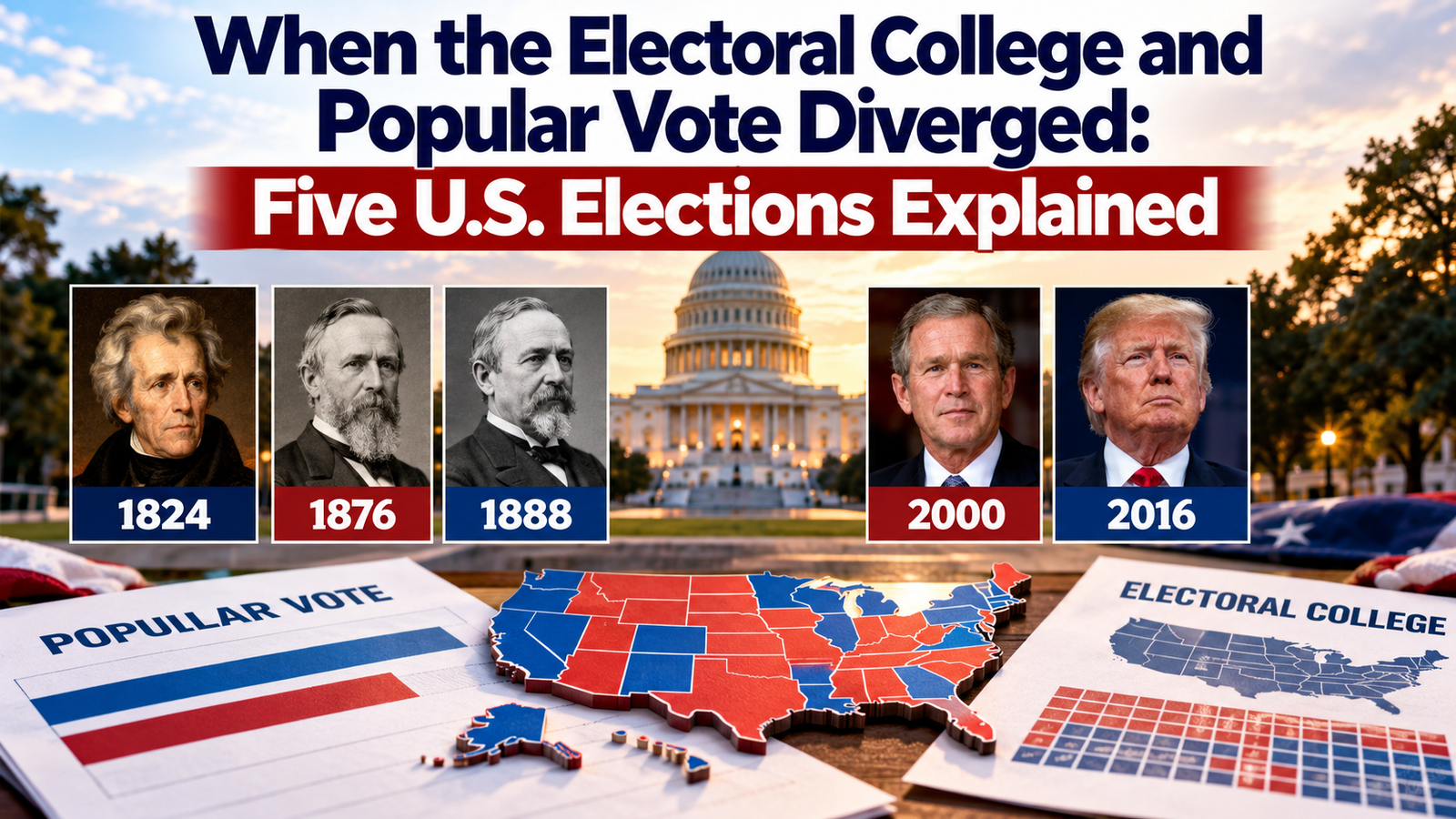
Americans vote for president every four years, but the presidency is not awarded to the candidate who simply receives the most votes nationwide. The constitutional system operates through the Electoral College, with electoral votes awarded through state-level results.
Four presidential elections—1876, 1888, 2000 and 2016—produced an Electoral College winner who received fewer popular votes nationwide than a principal opponent. The 1824 election is also commonly included in this history, but it requires an important qualification: six states did not hold a popular vote for presidential electors. The National Archives nevertheless lists these five elections together when discussing occasions when the Electoral College result differed from the popular-vote result.
These elections were not five versions of the same event. In 1824, no candidate won an Electoral College majority and the House of Representatives selected the president. In 1876, disputed electoral returns were resolved through a special Electoral Commission. In 1888 and 2016, the divergence resulted from the distribution of votes among the states. In 2000, Florida’s extremely close result and subsequent litigation proved decisive.
Understanding those differences is essential to understanding what these five elections actually tell us about the American presidential election system.
How Can the Electoral College and Popular Vote Produce Different Results?
The United States does not elect its president through a single national popular-vote contest. Presidential elections ultimately operate through the Electoral College.
Each state receives a number of electors, and a candidate must receive a majority of electoral votes to become president. If no presidential candidate receives the required majority, the Twelfth Amendment provides for the House of Representatives to choose the president from among the top three electoral-vote recipients, with each state delegation casting one vote.
For a more complete explanation of that process, see How U.S. Presidential Elections Work: A Step-by-Step Guide.
Because electoral votes come from state-level outcomes, the geographical distribution of votes matters. A candidate can build very large popular-vote margins in some states while narrowly losing other states whose electoral votes are sufficient to determine the election.
Today, most states and the District of Columbia use a winner-take-all approach to presidential electors, while Maine and Nebraska use a congressional-district method. The National Archives specifically notes that the Electoral College result can therefore differ from aggregated national popular-vote totals.
An Important Note About the “Popular Vote”
There is no constitutionally defined national popular vote that independently determines the presidency.
What is commonly called the national popular vote is an aggregation of votes reported by the states and the District of Columbia. For modern elections, organizations such as the Federal Election Commission compile official state results into national statistics.
Historical elections require additional caution. Voting rules, ballot access and methods of choosing electors changed substantially over time, and historical sources sometimes report slightly different totals.
That problem is particularly important in 1824, when six states did not choose their presidential electors through a popular vote at all.
For that reason, this article uses approximate figures where historical sources disagree rather than presenting uncertain numbers as exact.
1824 — Andrew Jackson and John Quincy Adams
The election of 1824 is fundamentally different from the other four elections discussed here.
Presidential electors were chosen through popular voting in 18 states, while the remaining six states used their legislatures to select electors. There was therefore no complete nationwide popular vote comparable to a modern presidential election.
Among the states where popular voting was used, Andrew Jackson received a plurality of the reported vote. National Archives historical material gives Jackson 152,901 votes in those states, compared with 114,023 for John Quincy Adams, 47,217 for Henry Clay and 46,979 for William H. Crawford. Historical compilations differ somewhat, however, so these figures should not be treated as a complete national vote.
The Electoral College produced no majority.
Jackson received 99 electoral votes, Adams 84, Crawford 41 and Clay 37. With 261 electoral votes in total, 131 were required for a majority.
Because nobody reached that threshold, the Twelfth Amendment sent the election to the House of Representatives. Only the top three electoral-vote recipients—Jackson, Adams and Crawford—were eligible for consideration.
The House voted by state delegation on February 9, 1825. Adams received the votes of 13 states, Jackson 7 and Crawford 4, making John Quincy Adams president.
Henry Clay, who was Speaker of the House, supported Adams. Adams subsequently appointed Clay Secretary of State. Jackson’s supporters accused the two men of making a “corrupt bargain.”
The sequence of events is documented, but the allegation of a bargain should not be presented as established fact. It became an important political accusation and later figured prominently in Jackson’s campaign against Adams.
1876 — Samuel Tilden and Rutherford B. Hayes
The election of 1876 presented a very different problem.
Democrat Samuel Tilden received more popular votes than Republican Rutherford B. Hayes, with historical sources generally placing Tilden’s advantage at roughly a quarter of a million votes.
But the electoral count was contested.
Tilden initially stood at 184 electoral votes—one short of the 185 needed for victory—while Hayes had 165. Twenty electoral votes remained disputed.
The disputed returns involved Florida, Louisiana, Oregon and South Carolina.
Congress responded by establishing a special Electoral Commission to resolve the competing electoral claims. The commission consisted of five senators, five representatives and five Supreme Court justices.
Its decisions awarded the disputed electoral votes to Hayes.
The final Electoral College result was:
Rutherford B. Hayes — 185
Samuel Tilden — 184
The National Archives confirms both the final 185–184 result and that the electoral votes of those four states were disputed and referred to the Electoral Commission.
Hayes therefore became president by a single electoral vote.
The election is also closely associated with the end of Reconstruction. Historians have debated whether there was a specific political bargain—often called the Compromise of 1877—linking acceptance of Hayes’s presidency to concessions involving the South.
Because the nature and scope of such an agreement remain matters of historical interpretation, it is safer to distinguish that debate from the documented electoral process: Congress created the commission, the commission resolved the disputed returns, and Hayes was declared elected 185–184.
1888 — Grover Cleveland and Benjamin Harrison
The election of 1888 did not require a contingent election, special electoral commission or Supreme Court intervention.
Incumbent President Grover Cleveland received more popular votes nationwide than Benjamin Harrison, with historical compilations putting Cleveland’s advantage at roughly 90,000 votes.
Harrison nevertheless won decisively in the Electoral College:
Benjamin Harrison — 233
Grover Cleveland — 168
A majority required 201 electoral votes. The National Archives confirms the final 233–168 result.
The explanation lies in the distribution of votes among the states.
Cleveland accumulated substantial vote totals in states he already carried, while Harrison assembled enough state victories to build a larger Electoral College majority.
New York was particularly important. Its 36 electoral votes went to Harrison despite a relatively narrow popular-vote margin there.
The result illustrates a basic feature of the Electoral College: additional votes beyond those needed to carry a winner-take-all state do not produce additional electoral votes.
A candidate can therefore receive more votes across the country while another candidate assembles the state-level victories needed for an Electoral College majority.
2000 — Al Gore and George W. Bush
The election of 2000 produced one of the closest and most litigated presidential contests in modern U.S. history.
According to the Federal Election Commission’s official compilation, Democrat Al Gore received:
50,992,335 votes — 48.38%
Republican George W. Bush received:
50,455,156 votes — 47.87%
That put Gore ahead nationally by 537,179 votes.
But the election turned on Florida.
The FEC’s certified figures for the state were:
George W. Bush — 2,912,790
Al Gore — 2,912,253
The difference was just 537 votes out of more than 5.9 million cast in Florida.
The extraordinarily close result triggered recount procedures and extensive litigation.
On December 8, 2000, the Florida Supreme Court ordered additional manual recounting of certain ballots. The dispute ultimately reached the U.S. Supreme Court in Bush v. Gore.
The Supreme Court concluded that the recount process ordered by the Florida court lacked constitutionally adequate uniform standards. A majority also concluded that there was insufficient time to conduct a constitutionally valid recount within the applicable federal timetable.
The recount therefore ended, leaving Florida’s certified result in place.
Bush received Florida’s 25 electoral votes.
The final Electoral College tally was:
George W. Bush — 271
Al Gore — 266
One District of Columbia elector abstained rather than casting a presidential vote, so only 537 of the possible 538 presidential electoral votes were cast for candidates. The FEC confirms both the 271–266 electoral result and the D.C. abstention.
Bush therefore became president despite Gore receiving more votes nationwide.
This article uses the certified election results rather than attempting to determine what alternative recount procedures might have produced. Such scenarios are separate from the official result.
2016 — Hillary Clinton and Donald Trump
Another Electoral College–popular vote divergence occurred in 2016.
According to the Federal Election Commission, Democrat Hillary Clinton received:
65,853,514 votes — 48.18%
Republican Donald Trump received:
62,984,828 votes — 46.09%
Clinton therefore received 2,868,686 more votes nationwide.
Trump nevertheless secured an Electoral College majority.
When the electors cast their ballots, the final presidential tally was:
Donald Trump — 304
Hillary Clinton — 227
Other candidates — 7
Seven electors voted for presidential candidates other than the candidates to whom they had been expected to cast their votes. Those votes did not affect which candidate had an Electoral College majority.
The result again reflected the distribution of votes across states rather than simply the nationwide total.
Trump carried several closely contested states that collectively provided important electoral votes, while Clinton accumulated particularly large popular-vote margins in some states she carried.
As in 1888, the divergence did not require the House to select a president. Nor did it require an Electoral Commission like 1876 or litigation determining a decisive state result like 2000.
The state-by-state Electoral College results produced the outcome.
Five Elections at a Glance
| Election | Most reported popular votes | Became president | Popular-vote difference | Electoral result | What determined the outcome? |
|---|---|---|---|---|---|
| 1824* | Andrew Jackson | John Quincy Adams | Not reliably comparable* | Jackson 99; Adams 84; Crawford 41; Clay 37 | No Electoral College majority; House selected Adams |
| 1876 | Samuel Tilden | Rutherford B. Hayes | Roughly 250,000 | Hayes 185; Tilden 184 | Disputed returns resolved through Electoral Commission |
| 1888 | Grover Cleveland | Benjamin Harrison | Roughly 90,000 | Harrison 233; Cleveland 168 | State-by-state Electoral College distribution |
| 2000 | Al Gore | George W. Bush | 537,179 | Bush 271; Gore 266 | Florida decided by 537 certified votes after recount litigation |
| 2016 | Hillary Clinton | Donald Trump | 2,868,686 | Trump 304; Clinton 227; others 7 | State-by-state Electoral College distribution |
*1824 is not directly comparable with the later elections. Six states selected presidential electors through their legislatures rather than a popular vote, so no complete nationwide popular-vote total existed.
Why Can the Results Diverge?
The basic explanation is that popular votes and electoral votes measure different things.
National popular-vote figures add together individual votes from across the states. The Electoral College instead converts state-level election results into electoral votes.
Suppose one candidate wins several states by extremely large margins while another wins a greater combination of electoral votes through narrower victories elsewhere. The first candidate can accumulate more votes nationally while the second reaches the Electoral College majority required for the presidency.
That basic state-by-state structure explains the divergences in 1888 and 2016.
The other elections involved additional complications.
In 1824, no candidate received an Electoral College majority, triggering a House contingent election.
In 1876, competing electoral returns required a special process in Congress.
In 2000, a 537-vote certified margin in Florida became decisive after recount litigation.
The same final phenomenon—one candidate receiving more reported popular votes while another becomes president—can therefore arise through very different historical circumstances.
Does the National Popular Vote Determine the Presidency?
No.
The national popular-vote total is an important measure of voter support, but it does not independently determine who becomes president.
The Electoral College determines whether a presidential candidate has obtained the required electoral majority. If no candidate receives that majority, the Constitution provides a contingent-election process in Congress.
The National Archives summarizes the distinction directly: the president is not selected by a national popular vote; Electoral College totals determine the winner.
That distinction is essential when interpreting all five elections discussed here.
Key Takeaway
The elections of 1824, 1876, 1888, 2000 and 2016 are commonly grouped together when discussing occasions when the presidential outcome diverged from reported popular-vote totals. But the circumstances were substantially different.
1824 requires the strongest qualification because no complete nationwide popular vote existed and the House ultimately selected the president after no candidate won an Electoral College majority.
1876 involved disputed electoral returns and a special Electoral Commission.
1888 produced a straightforward Electoral College victory for Benjamin Harrison despite Grover Cleveland receiving more votes nationwide.
2000 turned on a certified 537-vote margin in Florida and recount litigation that reached the Supreme Court.
2016 again demonstrated how the distribution of votes among states can produce an Electoral College majority for a candidate who receives fewer votes nationwide.
Understanding those differences is more useful than treating all five elections as identical examples of the same phenomenon.
Sources
- U.S. National Archives — 1824 Electoral College Results
- U.S. National Archives — The 1824 Presidential Election and the “Corrupt Bargain”
- U.S. National Archives — 1876 Electoral College Results
- U.S. National Archives — 1888 Electoral College Results
- U.S. National Archives — Electoral College Frequently Asked Questions
- Federal Election Commission — Federal Elections 2000
- Federal Election Commission — Federal Elections 2016
- U.S. Supreme Court — Bush v. Gore, 531 U.S. 98 (2000)
- Constitution Annotated — Twelfth Amendment
- U.S. House of Representatives, History, Art & Archives — historical material on the 1876 electoral count
Election-related information last reviewed September 2026. The American Elections is an independent educational resource and is not affiliated with any campaign, political party, or election authority.