
Last updated: September 25, 2026
On Tuesday, November 3, 2026, voters across the United States will elect members of Congress, governors, state legislators and many other state and local officials.
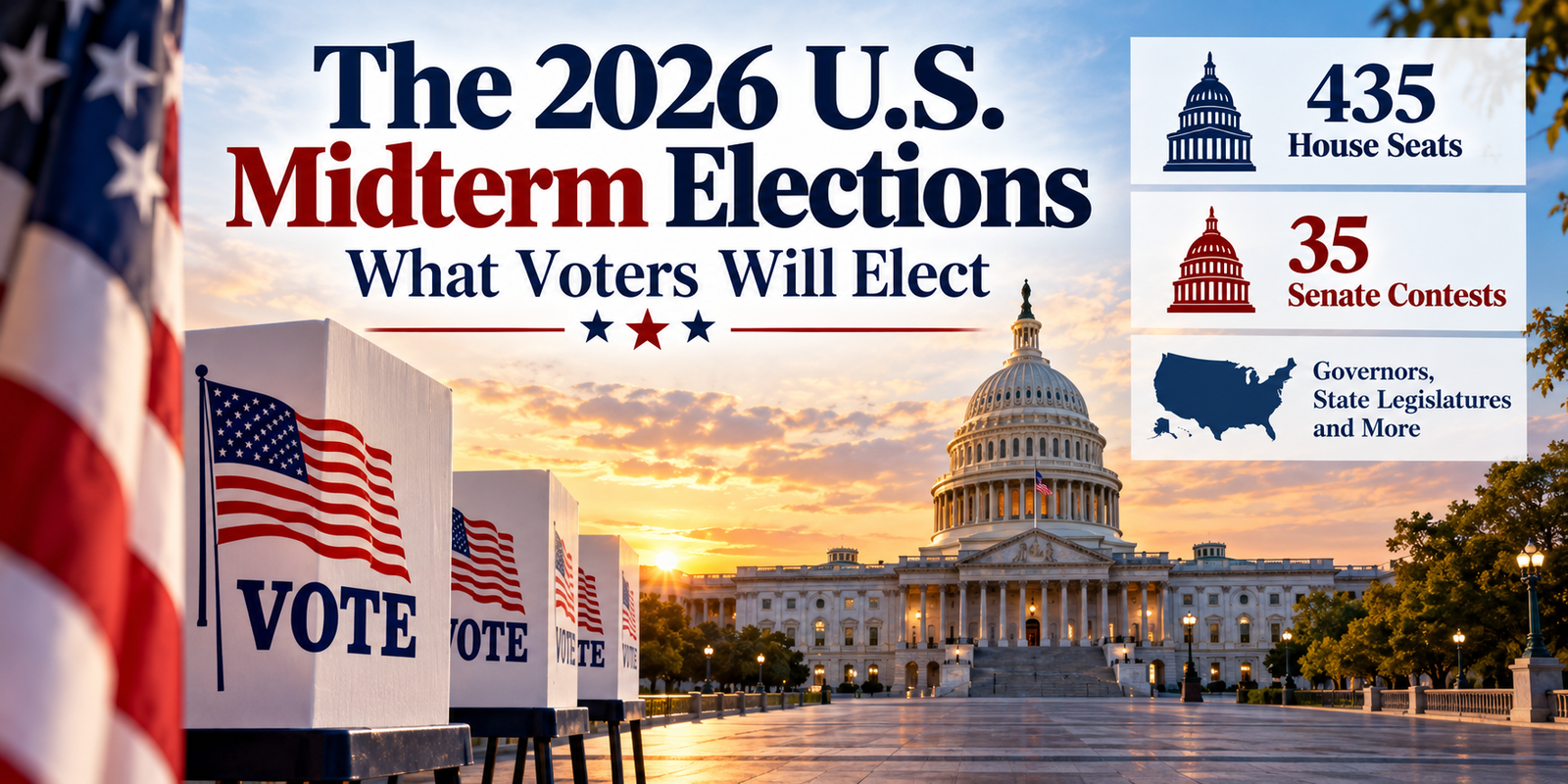
There is no presidential election in 2026. Instead, the federal ballot centers on the U.S. House of Representatives and Senate: all 435 voting House seats are up for election, along with 35 Senate contests—33 regularly scheduled Class II elections and two special elections in Florida and Ohio. The Senate’s official Class II roster confirms the 33 regularly scheduled seats.
Many voters will also choose governors, state legislators and other officials or decide ballot measures. What appears on an individual ballot depends on the voter’s state and locality.
This guide explains what Americans will elect in the 2026 midterms. It does not forecast election results.
When Are the 2026 Midterm Elections?
The 2026 general election is Tuesday, November 3, 2026. The National Governors Association and National Conference of State Legislatures both identify November 3 as the 2026 general-election date.
Voting does not necessarily begin or end with that date. Registration deadlines, early voting, mail voting, runoff procedures and other election rules vary by state.
Voters should therefore check their official state or local election authority for deadlines and voting procedures that apply where they live.
Is the President Being Elected in 2026?
No.
The president and vice president are elected to four-year terms. The most recent presidential election occurred in 2024, and the next regularly scheduled presidential election will occur in 2028.
The 2026 election falls halfway through the presidential term, which is why it is commonly described as a midterm election.
For a detailed explanation of presidential elections, see How U.S. Presidential Elections Work: A Step-by-Step Guide.
All 435 House Seats Are Up for Election
The U.S. House of Representatives has 435 voting seats, and representatives serve two-year terms.
Because House terms last two years, all 435 seats are regularly contested every two years—including during presidential-election years and midterm-election years.
That means voters will elect representatives for all 435 congressional districts in 2026.
Current House Vacancies
As of September 25, 2026, the Clerk of the U.S. House lists two vacancies:
- Florida’s 20th Congressional District
- Texas’s 23rd Congressional District
The Clerk currently lists the dates of the special elections for both vacancies as TBD.
These vacancies do not change the basic structure of the November election: all 435 House districts have regularly scheduled elections in 2026.
Congressional Districts
The 2026 House elections will use congressional districts established through state redistricting processes and subsequent court rulings.
District boundaries have changed in several states since the 2024 election, and some redistricting disputes have continued into the 2026 election cycle.
Missouri illustrates why this remains a moving issue. Its congressional map has been the subject of conflicting state and federal court proceedings during September 2026, with further Supreme Court action sought after a September 21 federal appeals-court decision.
Rather than relying on an older congressional map, voters should check their official state election authority for their current district.
Which Senate Seats Are Up in 2026?
There are 35 Senate contests scheduled for the 2026 general election:
- 33 regularly scheduled Class II elections
- 2 special elections, in Florida and Ohio
Senators normally serve six-year terms. The Senate’s 100 seats are divided into three classes so that approximately one-third of the Senate is regularly elected every two years.
The Senate’s official Class II roster identifies 33 Class II seats whose current terms expire on January 3, 2027.
The 33 regular Senate elections are in:
Alabama, Alaska, Arkansas, Colorado, Delaware, Georgia, Idaho, Illinois, Iowa, Kansas, Kentucky, Louisiana, Maine, Massachusetts, Michigan, Minnesota, Mississippi, Montana, Nebraska, New Hampshire, New Jersey, New Mexico, North Carolina, Oklahoma, Oregon, Rhode Island, South Carolina, South Dakota, Tennessee, Texas, Virginia, West Virginia and Wyoming.
Florida and Ohio are not Class II seats. Their 2026 elections are special elections for Class III seats.
Therefore:
33 regular elections + 2 special elections = 35 Senate contests.
The remaining 65 Senate seats are not on a 2026 ballot.
Regular Senate Elections vs. Special Elections
A regular Senate election occurs because a senator’s normal six-year term is ending.
A special election occurs when a vacancy requires voters to select someone to complete an unexpired term.
Ohio Special Election
JD Vance left his Senate seat in January 2025 to become vice president. Ohio Governor Mike DeWine appointed Jon Husted to the vacancy.
Ohio voters will elect a senator in a special election in 2026 to fill the remainder of the Class III term, which runs through January 3, 2029.
Florida Special Election
Marco Rubio left the Senate in January 2025 to become secretary of state. Florida Governor Ron DeSantis appointed Ashley Moody to the vacancy.
Florida voters will likewise hold a special Senate election in 2026 for the remainder of a Class III term ending January 3, 2029.
What About Oklahoma and South Carolina?
Two Class II seats are currently held by appointees, but their 2026 contests remain regular elections, not additional special elections.
The Senate’s current Class II roster includes Alan Armstrong of Oklahoma and Darline Graham of South Carolina among the senators serving in Class II seats whose terms expire January 3, 2027.
This distinction is important when counting the 2026 Senate contests.
2026 Federal Elections at a Glance
| Office | Seats/Contests | Normal Term | 2026 Status |
|---|---|---|---|
| U.S. House | 435 | 2 years | All voting seats elected |
| U.S. Senate — regular | 33 | 6 years | Class II |
| U.S. Senate — special | 2 | Remainder of term | Florida and Ohio |
| Total Senate contests | 35 | — | 33 regular + 2 special |
| President/Vice President | 0 | 4 years | Not elected in 2026 |
Governors and State Elections in 2026
The midterms extend well beyond Congress.
Governors
The National Governors Association reports 39 gubernatorial elections in 2026 when three territories are included. That corresponds to gubernatorial elections in 36 states, plus three territories. The general election is scheduled for November 3.
Unlike most states, New Hampshire and Vermont elect governors to two-year terms.
New Jersey and Virginia held their gubernatorial elections in 2025 rather than 2026.
State Legislatures
State legislative elections will also take place on a large scale.
According to the National Conference of State Legislatures, voters in 46 states will elect state legislators in November 2026.
Those elections cover:
- 88 of the nation’s 99 state legislative chambers
- 6,139 regularly scheduled legislative seats
- approximately 83% of all state legislative seats nationwide
Depending on the state, voters may also elect attorneys general, secretaries of state, treasurers, judges and other state officials.
Ballot Measures and Local Elections
Some voters will also decide ballot initiatives, referendums or proposed constitutional amendments.
NCSL confirms that ballot measures affecting state laws or constitutions will appear before voters in various states in 2026.
Local ballots can contain additional contests for county and municipal offices, judges, school boards and other positions.
This means there is no single nationwide 2026 ballot. The precise ballot depends on where a voter lives.
Why Are They Called Midterm Elections?
The term comes from the different lengths of federal terms.
House of Representatives: 2 years
President: 4 years
Senate: 6 years, with seats divided into three classes
House elections therefore occur every two years.
Presidential elections occur every four years.
The congressional election that occurs halfway through a president’s four-year term is commonly called the midterm election.
The Senate operates differently because only one of its three classes is regularly scheduled for election in each two-year cycle.
For more detail, see Midterm Elections Explained: How House and Senate Elections Work.
What Does Control of Congress Mean?
The November elections determine the membership of the next House and the senators elected in the 2026 cycle.
Which party holds a majority in each chamber affects how that chamber is organized and operates.
House of Representatives
The House elects its Speaker. The majority party generally has substantial influence over committee leadership and the chamber’s legislative agenda.
Senate
The Senate majority affects chamber leadership, committee organization and much of the floor schedule.
The Senate also considers presidential nominations requiring Senate confirmation, including many executive-branch officials and federal judges.
Legislation Still Involves Both Chambers
Control of one chamber does not give a political party unrestricted authority over the federal government.
For most federal legislation to become law, the House and Senate must approve the same legislation before it is presented to the president. The president can sign or veto legislation, and the Constitution provides a congressional procedure for overriding a veto.
When Does the New Congress Take Office?
Election Day and taking office are separate events.
The Twentieth Amendment provides that the terms of senators and representatives begin and end at noon on January 3.
Accordingly, terms for members elected in the regular 2026 congressional elections begin at noon on January 3, 2027.
That date falls on a Sunday. The Constitution provides that Congress assembles at noon on January 3 unless a different day is appointed by law.
The exact timing for seating senators elected in the Florida and Ohio special elections can depend on certification and Senate procedures, so this article does not assign them a specific earlier swearing-in date.
Current Composition of Congress
As of September 25, 2026.
The composition of Congress can change because of vacancies, appointments, special elections or other events.
The Senate currently has 53 Republicans, 45 Democrats and 2 independents, according to the Senate’s current roster.
The House currently has 218 Republicans, 214 Democrats, 1 independent and 2 vacancies, according to the House Clerk.
These figures provide context for the election but do not predict its outcome. They should be rechecked as Election Day approaches.
How to Find What’s on Your Ballot
Election administration is decentralized in the United States.
Rules for:
- voter registration
- early voting
- mail voting
- voter identification
- registration deadlines
- ballot-return deadlines
can differ by state.
Use Vote.gov to reach official state election resources, and check your state or local election authority for your registration status, voting rules and sample ballot.
The American Elections is an independent educational resource, not an election authority.
Key Dates
| Date | Event |
|---|---|
| November 3, 2026 | 2026 general election |
| November 3, 2026 | 33 regular Senate elections and Florida/Ohio Senate special elections |
| January 3, 2027, noon | Terms for members elected to the new Congress begin |
| January 3, 2029 | Current Class III terms involved in the Florida and Ohio special elections expire |
Key Takeaways
- The 2026 general election is November 3, 2026.
- There is no presidential election in 2026.
- All 435 voting House seats are up for election.
- There are 33 regular Class II Senate elections.
- Florida and Ohio also hold Senate special elections, bringing the Senate total to 35 contests.
- 36 states hold gubernatorial elections.
- Voters in 46 states will elect 6,139 state legislators in regularly scheduled elections.
- State and local ballots may also contain other offices and ballot measures.
- Members elected to regular congressional terms begin those terms at noon on January 3, 2027.
Sources
For the reader-facing Sources section, use these primary/authoritative sources:
- U.S. Senate — Class II Senators
- U.S. Senate — Senators
- Clerk of the U.S. House — Members
- Clerk of the U.S. House — Vacancies of the 119th Congress
- Congress.gov — Constitution Annotated
- National Governors Association — 2026 Elections
- National Conference of State Legislatures — State Elections 2026
- Vote.gov
Election-related information last updated September 25, 2026. The American Elections is an independent educational resource and is not affiliated with any campaign, political party, or election authority.