
Understanding how U.S. presidential elections work means looking beyond a single Election Day. It
is a months-long process involving candidates, political parties, state
election systems, voters, presidential electors, Congress, and finally
the inauguration of the next presidential term.
The basic sequence is straightforward: candidates seek a party
nomination, states and parties hold primaries or caucuses, parties
nominate their tickets, voters participate in the November general
election, states certify their results, electors cast the formal
electoral votes, and Congress counts those votes.
This guide explains each stage and separates federal constitutional
rules from state law and political-party rules, which can change from
one election cycle to another.
Who Can Become President?
Article II of the U.S. Constitution sets three basic qualifications. A
president must be a natural-born U.S. citizen, be at least 35 years old,
and have been a U.S. resident for at least 14 years.
The 22nd Amendment separately limits how many times a person may be
elected president. In general, a person may be elected president no more
than twice. A person who serves more than two years of a presidential
term to which someone else was elected may be elected only once more.
These constitutional rules are different from campaign-registration and
ballot-access rules. Meeting the constitutional qualifications does not
automatically place someone’s name on every state ballot.
Step 1: Candidates Enter the Race
There is no single federal filing that puts a presidential candidate on
every ballot nationwide.
For federal campaign-finance purposes, an individual becomes a candidate
after raising or spending more than $5,000 in contributions or
expenditures for a federal campaign. The Federal Election Commission
requires the candidate to file a Statement of Candidacy, or Form 2,
within 15 days after becoming a candidate and to designate a principal
campaign committee.
Ballot access is a separate matter. States set requirements for
appearing on primary and general-election ballots, and those
requirements can differ for major-party, minor-party, and independent
candidates.
That distinction matters: federal campaign registration and state ballot
access are related to running for president, but they are not the same
process.
Step 2: Primaries and Caucuses Help Parties Choose Nominees
Presidential primaries and caucuses help political parties determine
which candidate will become their nominee.
A primary is generally an election in which voters cast ballots for
their preferred candidate. A caucus is a party-run meeting or
process in which participants express their preferences and help
determine delegate allocation.
Rules differ across states and parties. Some contests are open to voters
regardless of party registration, while others restrict participation to
voters registered with a particular party. Semi-open and semi-closed
systems also exist.
The results are used to allocate delegates. Those delegates later
participate in the party’s national convention.
Why delegate rules can be complicated
Delegate allocation is governed largely by political-party rules, not by
one nationwide federal formula. Parties can use different thresholds,
proportional systems, winner-take-all or winner-take-most arrangements,
and other rules.
Because parties can revise these rules from one presidential cycle to
another, a durable explainer should not treat one cycle’s delegate
formulas or primary calendar as permanent.
Step 3: Parties Hold National Conventions
After the primary and caucus season, political parties hold national
conventions.
Delegates formally nominate the party’s presidential candidate. The
party also nominates a vice-presidential candidate, usually after the
presidential nominee has selected a running mate.
Most modern conventions begin with a presumptive nominee already clear
from the delegate results. If no candidate has secured the required
delegate support, convention rules determine how additional ballots and
delegate voting work.
These procedures are party rules rather than constitutional
requirements, so details can change between election cycles.
Step 4: The General Election
The presidential general election takes place every four years on the
Tuesday after the first Monday in November.
Major-party nominees appear on state ballots, while minor-party and
independent candidates may also qualify under each state’s ballot-access
laws.
In the general election, a registered voter may vote for any
presidential candidate on the ballot regardless of which party the voter
is registered with or whether the voter participated in a primary.
Registration deadlines, voter-identification requirements, early voting,
absentee voting, and voting by mail vary by state. North Dakota is the
only state that does not require voter registration.
For current voting rules, voters should rely on their state or local
election office rather than assuming that another state’s procedures
apply to them.
What Are Voters Actually Voting For?
A presidential ballot usually displays the names of the presidential and
vice-presidential candidates. Legally, however, the presidential
election operates through the Electoral College.
The November vote determines which presidential electors are appointed
under each state’s rules. Those electors later cast the formal votes for
president and vice president.
This is why the national popular-vote total does not itself determine
who becomes president. The legally decisive count is the Electoral
College vote.
Step 5: The Electoral College
The Electoral College is a process, not a building or permanent body.
It includes three major stages:
- States appoint presidential electors.
- Those electors meet in their respective states and vote for
president and vice president. - Congress counts the electoral votes.
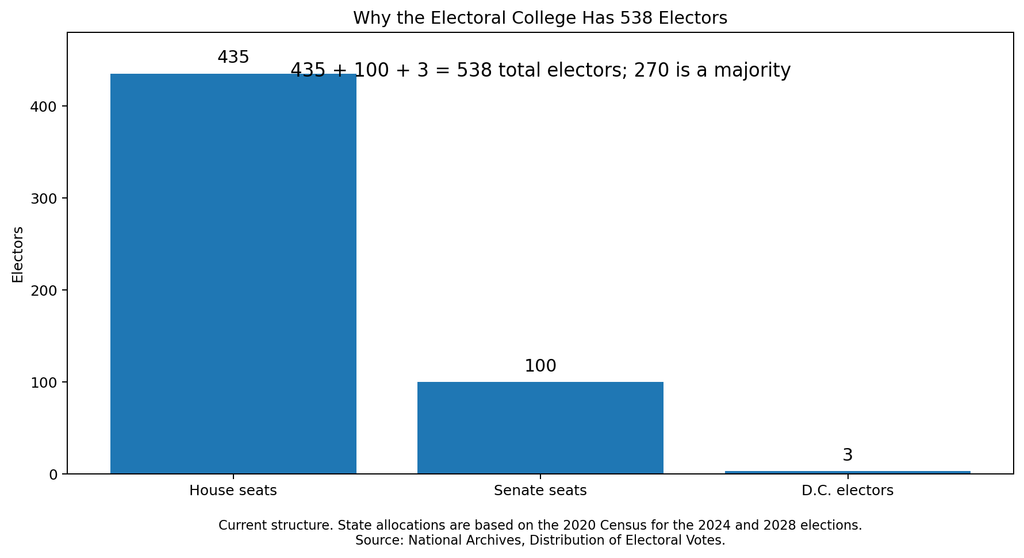
Why are there 538 electors?
Each state receives a number of electors equal to its total
representation in Congress: its members of the House of Representatives
plus its two senators.
The current total is:
- 435 corresponding to House seats
- 100 corresponding to senators
- 3 for the District of Columbia under the 23rd Amendment
That produces 538 electors.
A majority is currently 270 electoral votes.
The state-by-state allocation now in effect is based on the 2020 Census
and applies to the 2024 and 2028 presidential elections. State
allocations will be recalculated after the 2030 Census for the 2032
election.
Winner-take-all, Maine, and Nebraska
Forty-eight states and the District of Columbia currently use a
winner-take-all method: the statewide popular-vote winner receives all
of that jurisdiction’s electoral votes.
Maine and Nebraska use a congressional-district method. Each awards one
elector to the popular-vote winner in each congressional district and
two at-large electors to the statewide winner.
These allocation methods are determined by state law. They are not
permanent features of the U.S. Constitution.
Step 6: Election Night Is Not the End
Results reported on election night are unofficial.
Election officials continue processing eligible ballots according to
state law. States and local jurisdictions then conduct post-election
procedures that can include canvassing, reconciliation, audits, and
certification.
A canvass is the official process of accounting for ballots and
confirming election data. Certification is the formal action by
which election officials attest to the official results.
This creates an important distinction:
- Projected result: a call made by a news organization or other
outside organization; it has no legal effect. - Unofficial result: an election-office result reported before
certification. - Certified result: the official result after the legally required
state and local processes are completed.
Certification procedures and deadlines vary by state.
Step 7: States Appoint Electors and the Electors Vote
Under current federal law, a state’s executive must issue its
Certificate of Ascertainment of Appointment of Electors no later than
six days before the electors are scheduled to meet.
The electors then meet in their respective states, not as one
national group in Washington.
Federal law now sets that meeting for the first Tuesday after the
second Wednesday in December following their appointment.
At the meeting, electors vote separately for president and vice
president. Their votes are recorded in Certificates of Vote and
transmitted as required by federal law.
Some states legally bind electors to the candidates they were selected
to support. The Constitution itself does not impose a uniform nationwide
requirement that every elector vote according to the state’s
popular-vote result.
Step 8: Congress Counts the Electoral Votes
Congress meets in joint session on January 6 following the electors’
meeting to count the electoral votes, under current federal law.
The vice president, acting as President of the Senate, presides. The
Electoral Count Reform Act of 2022 clarified that this role is
ministerial: the presiding officer cannot unilaterally decide which
electoral votes to accept or reject.
An objection to electoral votes must satisfy the requirements in federal
law, including support from at least one-fifth of the duly chosen and
sworn members of both the Senate and the House. The law limits
objections to specified grounds.
If a qualifying objection is considered, the House and Senate decide
separately. Both chambers must sustain the objection for the affected
electoral vote or votes to be rejected.
What Happens If Nobody Wins an Electoral-Vote Majority?
If no presidential candidate receives a majority of the electors
appointed, the 12th Amendment provides a contingent election.
The House of Representatives chooses the president from among the top
three presidential electoral-vote recipients. But representatives do not
vote individually in the usual way. Each state delegation has one vote,
and a majority of the states is required to elect the president.
The Senate chooses the vice president from the top two vice-presidential
electoral-vote recipients, with each senator voting individually.
This is a rare constitutional fallback, not a normal part of modern
presidential elections.
Step 9: The Presidential Term Begins
The 20th Amendment provides that the terms of the president and vice
president end at noon on January 20, and the terms of their successors
then begin.
The public inauguration ceremony normally takes place on January 20.
When January 20 falls on a Sunday, the public ceremony is traditionally
held on January 21, but the constitutional transfer of the presidential
term still occurs at noon on January 20.
The president takes the oath of office specified in Article II of the
Constitution.
At that point, the presidential election process that began long before
Election Day has reached its constitutional conclusion.
Common Misconceptions About Presidential Elections
“The president is elected by a national popular vote.”
No. Voters participate in state-level elections that determine the
appointment of electors. The Electoral College vote determines the
presidential winner.
“Winning the national popular vote guarantees the presidency.”
No. A candidate can receive more votes nationwide and still lose the
Electoral College. This has occurred in U.S. history, including in 2000
and 2016.
“News organizations officially decide who won.”
No. News organizations may project winners, but projections have no
legal effect. Election officials canvass and certify results, electors
vote, and Congress counts the electoral votes.
“The vice president can reject electoral votes.”
No. Current federal law explicitly describes the President of the
Senate’s role during the congressional count as ministerial and denies
unilateral authority to accept or reject electoral votes.
“Every state runs elections the same way.”
No. State laws differ on registration, voter identification, early
voting, mail voting, primary participation, certification, and other
procedures.
“A candidate must win most states to become president.”
No. The normal constitutional requirement is a majority of electoral
votes, currently 270 of 538. A state-by-state House vote occurs only in
the contingent-election process when no presidential candidate wins an
Electoral College majority.
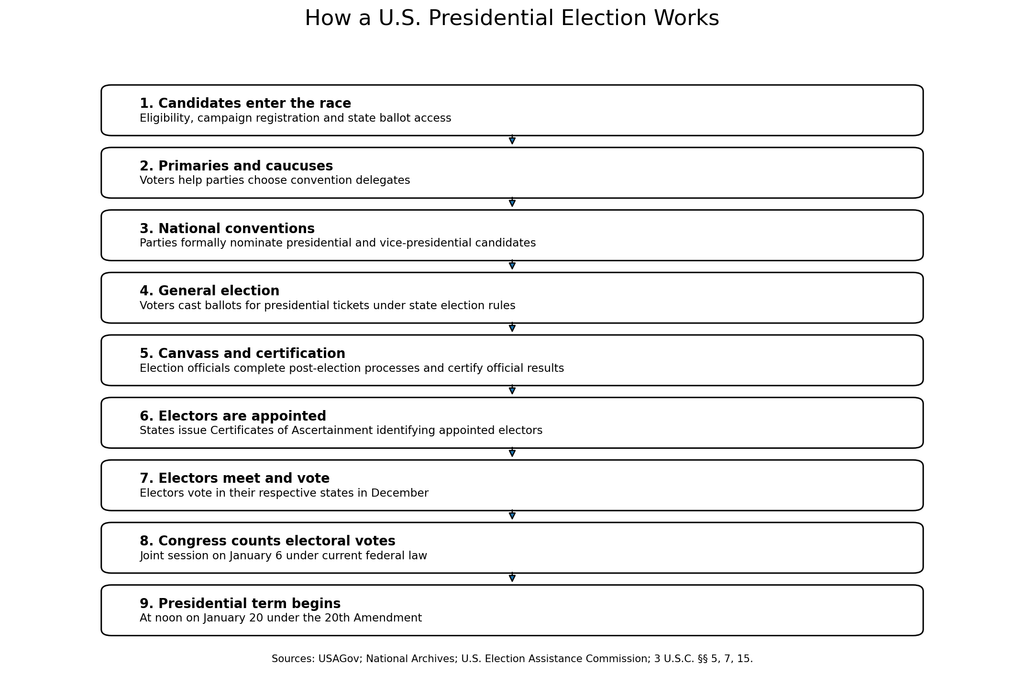
The Presidential Election Process in One View
Candidate → Primaries/Caucuses → National Convention → General
Election → State Canvass & Certification → Electors Vote → Congress
Counts → Presidential Term Begins
The important point is that Election Day is only one stage in a longer
constitutional and legal process.
Key Takeaway
U.S. presidential elections combine constitutional rules, federal
statutes, state election laws, and political-party procedures.
Some features are highly stable, such as the constitutional
qualifications for president and the basic Electoral College framework.
Others—including primary calendars, delegate rules, ballot access,
voter-registration procedures, and voting methods—can change from one
election cycle or state to another.
For that reason, readers looking for instructions on how or when to vote
should always verify current information with their state or local
election authority.
Sources
- USAGov — Presidential Election Process
- USAGov — Constitutional Requirements for Presidential Candidates
- USAGov — Presidential Primaries and Caucuses
- USAGov — Presidential General Election
- USAGov — Electoral College
- Federal Election Commission — Registering a Candidate
- National Archives — What Is the Electoral College?
- National Archives — Distribution of Electoral Votes
- U.S. Election Assistance Commission — Election Results, Canvass, and Certification
- U.S. Code — 3 U.S.C. §5: Certificate of Ascertainment of Appointment of Electors
- U.S. Code — 3 U.S.C. §7: Meeting and Vote of Electors
- U.S. Code — 3 U.S.C. §15: Counting Electoral Votes in Congress
- National Archives — Legal Provisions Relevant to the Electoral College Process
- USAGov — Inauguration of the President of the United States