
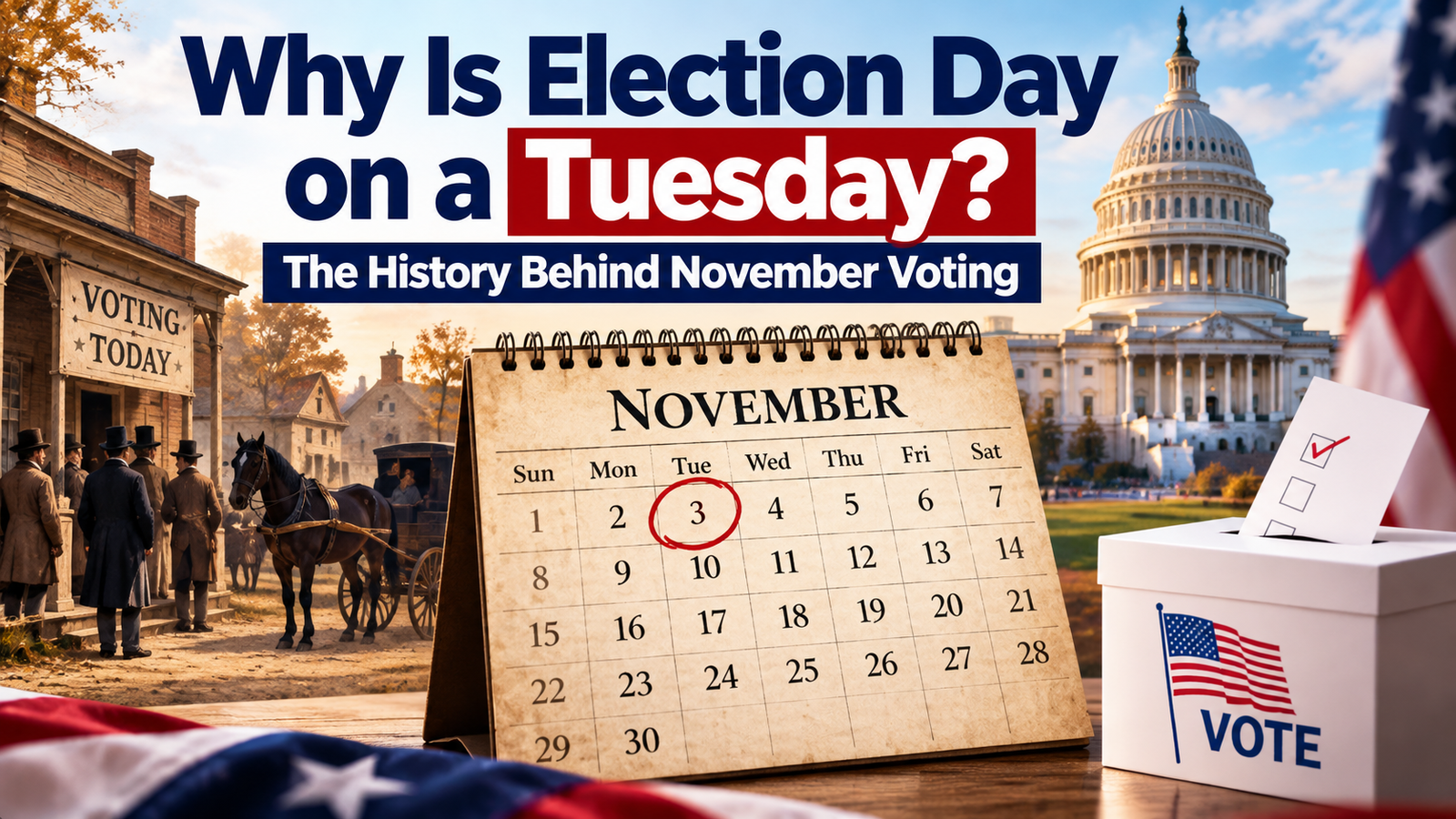
Every two years, Americans vote in federal general elections on a date that can sound unusually specific: the Tuesday after the first Monday in November.
In 2026, that date is November 3. In a presidential election year such as 2028, it will be November 7.
The formula dates to an 1845 federal law establishing a uniform day for states to appoint presidential electors. Congress later applied the same basic timing to elections for the House of Representatives and, following the adoption of direct election of senators, to the Senate.
But there is an important distinction between what the historical record establishes and the familiar stories about farmers, Sunday church attendance and Wednesday market days.
Those explanations provide useful historical context. They should not, however, be treated as documented statements of why Congress selected Tuesday and November.
The Short Answer
Federal Election Day is the Tuesday after the first Monday in November because federal law establishes that timing.
Congress first adopted the formula for presidential electors in 1845. Before then, states could appoint their electors on different days within a federally prescribed period. One documented concern behind creating a uniform date was the potential for fraud associated with elections occurring at different times.
The familiar explanations for choosing November and Tuesday—including the agricultural calendar, travel after Sunday worship and Wednesday market days—fit the circumstances of nineteenth-century America. But surviving evidence does not establish them as definitive statements of congressional intent.
What Is the Federal Election Day?
For federal general elections, several statutes work together to establish Election Day.
For presidential elections, current federal law defines Election Day as the Tuesday next after the first Monday in November every four years. The law also contains a provision addressing extraordinary and catastrophic force-majeure events when state law enacted beforehand allows modification of the voting period.
For elections to the House of Representatives, 2 U.S.C. §7 establishes the Tuesday after the first Monday in November in every even-numbered year as the regular election date for Representatives and Delegates.
For the Senate, 2 U.S.C. §1 provides that senators are elected at the regular election preceding the expiration of their terms at which a Representative is regularly chosen.
Because Election Day is the Tuesday after the first Monday—not simply the first Tuesday—it always falls between November 2 and November 8.
What Elections Looked Like Before 1845
The Constitution did not originally establish one nationwide date on which Americans would vote for presidential electors.
Congress initially allowed states considerably more flexibility.
Under legislation enacted in 1792, states could appoint their presidential electors during a period before the date on which the electors themselves met to vote. As a result, presidential voting did not necessarily occur simultaneously across the country.
By the 1840s, Congress moved toward replacing this staggered system with a uniform date.
That change produced the Election Day formula Americans still recognize today.
Congress Creates a Uniform Presidential Election Day
On January 23, 1845, Congress enacted An Act to establish a uniform time for holding elections for electors of President and Vice President in all the States of the Union.
Its central provision required presidential electors to be appointed in each state on:
“the Tuesday next after the first Monday in the month of November”
The statute applied specifically to the appointment of presidential and vice-presidential electors. It did not yet create a single Election Day for every federal office.
For a broader explanation of how electors fit into the presidential election process, see How U.S. Presidential Elections Work: A Step-by-Step Guide.
The first presidential election conducted under the uniform-date system occurred in 1848.
Why did Congress want the states voting on the same day?
The strongest documentary evidence concerns fraud associated with staggered elections. CRS reports that during congressional consideration of the legislation, supporters described the uniform-date proposal as a measure intended to guard against fraud in presidential elections.
The Supreme Court discussed the same historical problem in its 2026 Watson decision, describing concerns arising when states held elections on different days.
Later accounts sometimes add another explanation: results from states voting earlier could influence voters in states holding elections later. That concern is well documented in connection with the later establishment of a uniform congressional Election Day, but the evidence is less direct for treating it as a stated congressional motive in 1845.
Why November?
This is where the history becomes less certain.
The 1845 statute does not explain why Congress selected November, and the historical material reviewed for this article does not provide a definitive congressional statement saying that November was selected for one particular reason.
The most common explanation concerns the nineteenth-century agricultural calendar.
Much of the United States was then rural and agricultural. Early November fell after much of the autumn harvest but before the most difficult winter weather in many parts of the country.
CRS discusses this historical explanation when describing why early November suited conditions at the time.
There was also continuity with the existing presidential-election calendar. The previous system had already allowed states to select electors during a period leading up to the electors’ December meeting.
Early November therefore fit within an electoral timetable that was already familiar.
These circumstances make November understandable historically. They should not be converted into a claim that Congress explicitly declared, for example, “we chose November because farmers had finished harvesting.”
The surviving evidence does not establish the motive that precisely.
Why Tuesday?
The explanation most Americans encounter goes something like this:
In the nineteenth century, some voters had to travel considerable distances to reach polling places. Sunday was widely observed as a Christian Sabbath, making Sunday travel undesirable. Monday could therefore serve as a travel day, followed by voting on Tuesday.
CRS discusses this explanation, citing historical scholarship about the practical difficulties of requiring voters from remote areas to travel on Sunday.
Another frequently repeated explanation says that Wednesday was commonly a market day, making Tuesday more convenient.
Again, caution is warranted.
These explanations are plausible in the context of nineteenth-century American life and are widely repeated in historical accounts. But the evidence reviewed here does not establish that Congress formally chose Tuesday because legislators explicitly decided:
Sunday = church, Monday = travel, Tuesday = voting, Wednesday = market.
That neat sequence is better treated as a historical explanation than as a documented statement of congressional intent.
Why “Tuesday After the First Monday”?
Congress could simply have specified the first Tuesday in November.
It did not.
Instead, the law says the Tuesday after the first Monday. That distinction means Election Day cannot fall on November 1. Its earliest possible date is November 2 and its latest is November 8.
CRS discusses an historical explanation that the first day of a month was significant for merchants who used it for accounting and settling the previous month’s books.
Another story sometimes given is that November 1 was avoided because it is All Saints’ Day.
The evidence for treating that explanation as Congress’s reason is weak.
What we can state confidently is much simpler:
The statutory formula prevents federal Election Day from falling on November 1.
Why Congress considered that result desirable is less firmly documented than the formula itself.
How Congressional Elections Came to Use the Same Date
The 1845 law dealt with presidential electors, not all federal elections.
Congress addressed House elections later.
Legislation enacted in 1872 established the Tuesday after the first Monday in November as the regular date for elections to the House of Representatives. The current provision, 2 U.S.C. §7, traces its codification to that 1872 act.
The change helped create a more uniform federal-election calendar.
The Senate followed a different path because senators were originally selected by state legislatures, rather than directly by voters.
The Seventeenth Amendment, ratified in 1913, established direct popular election of senators.
Congress then enacted legislation in 1914 providing for senators to be elected at the regular election at which Representatives are chosen. That rule is reflected today in 2 U.S.C. §1.
Thus, today’s familiar federal Election Day emerged in stages:
1845 — presidential electors
1872 — House elections
1914 — Senate elections following direct election under the Seventeenth Amendment
Does Every Election Happen on Election Day?
No.
The federal Election Day statutes establish timing for regular federal general elections. They do not require every election held anywhere in the United States to occur on that date.
States and local governments conduct numerous elections at other times, and primary elections operate under a different set of rules.
For more on that distinction, see Primary vs. General Election: What’s the Difference?
Special elections and runoff elections can also occur on other dates when applicable law provides for them.
The Supreme Court addressed an important aspect of the federal rule in Foster v. Love in 1997. The case concerned Louisiana’s election system, under which congressional candidates could effectively win office before the federally prescribed November Election Day.
The Court concluded that federal law prevented a congressional election from being completed before the federal Election Day.
The key point is therefore not that all voting activity everywhere must happen only on one Tuesday, but that federal law establishes Election Day for the regular federal general election.
What About Early Voting and Mail Voting?
Modern voting practices make the phrase “Election Day” somewhat misleading if interpreted as meaning that every ballot must physically be cast at a polling place on that Tuesday.
Many states permit forms of early or absentee voting under state law.
The Supreme Court addressed another aspect of this issue in Watson v. Republican National Committee, decided June 29, 2026.
The case concerned Mississippi’s rule allowing certain absentee ballots postmarked by Election Day to be counted if election officials received them within five business days afterward.
In a 5–4 decision, the Supreme Court held that the federal Election Day statutes do not prohibit states from counting such ballots merely because election officials receive them after Election Day. The majority distinguished between the voter making a choice and election officials subsequently receiving and counting that ballot. The Court reversed the lower-court judgment and remanded the case.
The decision does not mean that every state follows the same mail-ballot deadlines. Those rules vary by jurisdiction.
For voters, the practical rule remains straightforward: check the deadlines established by your state election authority.
Has Congress Considered Changing Election Day?
Yes.
Members of Congress have periodically introduced legislation concerning Election Day, including proposals to make it a federal holiday or change aspects of when voting occurs.
Introducing legislation does not change Election Day by itself. Unless legislation is enacted, the existing federal statutory framework remains in force.
As of September 2026, the regular federal election date remains the Tuesday after the first Monday in November.
Key Takeaway
Election Day falls on the Tuesday after the first Monday in November because federal law establishes that schedule.
The rule began with presidential electors in 1845, when Congress replaced a system in which states could select electors on different dates with a uniform date. Preventing fraud associated with staggered voting is among the best-documented reasons for creating that uniform system.
Congress later extended the November election schedule to the House, and Senate elections were aligned with House elections after the adoption of direct election of senators.
The familiar explanations for why November and why Tuesday—agriculture, winter travel, Sunday worship and market schedules—fit the historical setting and appear in later historical accounts. But they should not be presented as conclusively documented statements of Congress’s intent.
That distinction separates what the law and legislative history establish from the much neater Election Day story that is often repeated today.
Sources
- U.S. Statutes at Large — Act of January 23, 1845, 5 Stat. 721
- Congressional Research Service — Election Day: Frequently Asked Questions
- U.S. Code — 2 U.S.C. §1, Time for Election of Senators
- U.S. Code — 2 U.S.C. §7, Time of Election
- U.S. Code — 3 U.S.C. §21, Definitions
- U.S. Supreme Court — Foster v. Love, 522 U.S. 67 (1997)
- U.S. Supreme Court — Watson v. Republican National Committee, No. 24-1260 (June 29, 2026)
- U.S. Constitution — Article I, Article II and the Seventeenth Amendment
Election-related information last reviewed September 2026. The American Elections is an independent educational resource and is not affiliated with any campaign, political party, or election authority.