
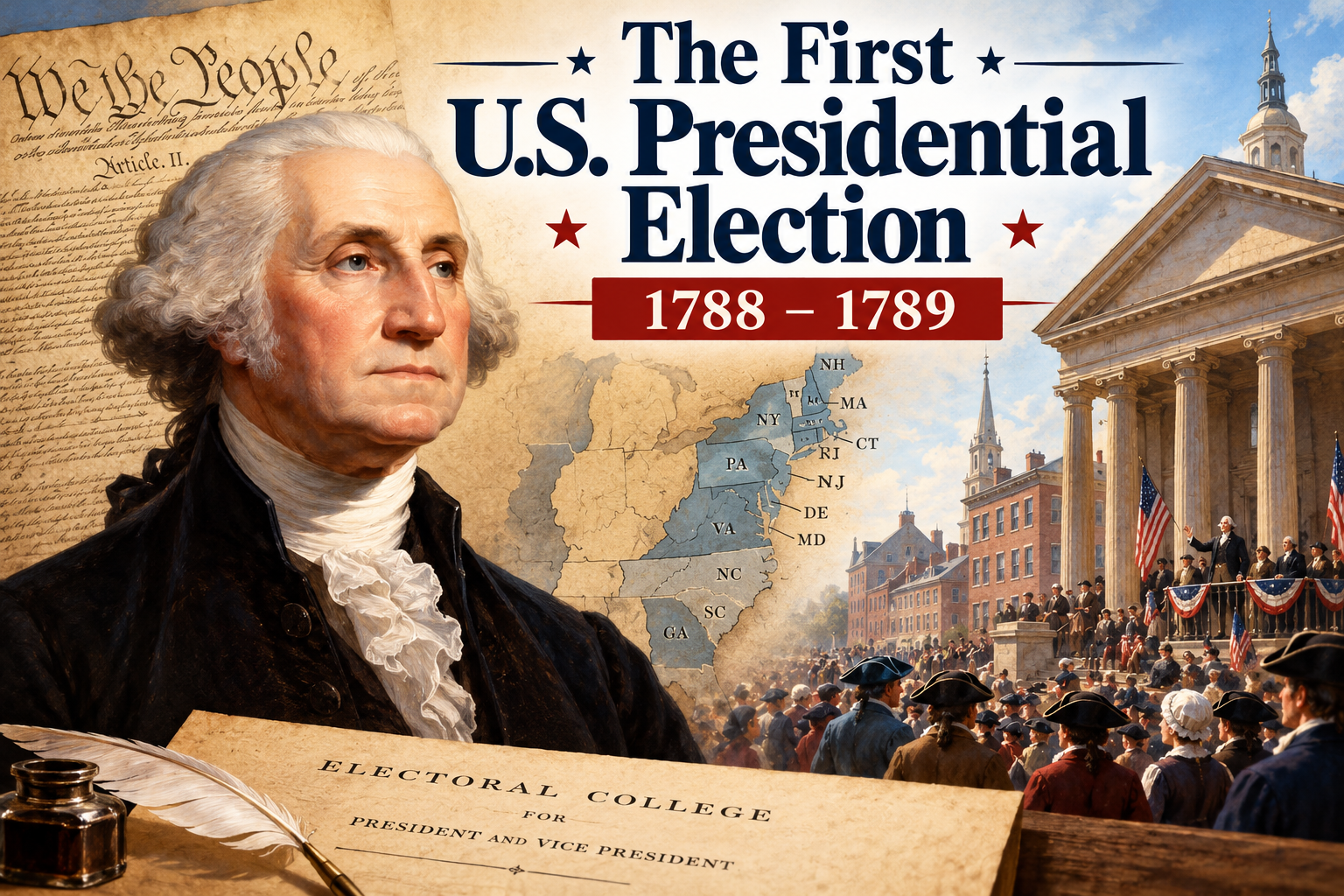
The first U.S. presidential election looked very different from the elections Americans know today. There was no single nationwide Election Day, no reliable national popular-vote total, and no separate Electoral College ballots for president and vice president.
The process stretched across 1788 and 1789. When it ended, George Washington received a vote from every one of the 69 electors who cast ballots, while John Adams finished second with 34 votes and became the nation’s first vice president. The National Archives records Washington’s 69–34 advantage over Adams and another 35 votes distributed among ten other individuals.
Understanding that result requires understanding an Electoral College system that worked differently from today’s.
When Was the First U.S. Presidential Election?
The first presidential election is usually described as the 1788–1789 election because the process crossed two calendar years.
After New Hampshire became the ninth state to ratify the Constitution in June 1788, the Confederation Congress established a timetable for putting the new constitutional government into operation.
States began parts of their elector-selection processes in late 1788. The designated date for appointing electors was January 7, 1789, and the electors cast their ballots in their respective states on February 4, 1789. Claude’s source chronology places the congressional count on April 6 and Washington’s inauguration on April 30.
There was therefore nothing resembling today’s single nationwide presidential Election Day. States also used different methods to select their electors.
How the First Electoral College Worked
The original Constitution established a system significantly different from the one used today.
Each state appointed electors in a manner determined by its legislature. The number of electors allocated to a state corresponded to its representation in Congress.
But the original system did not give electors separate presidential and vice-presidential ballots.
Instead, each elector voted for two different people, with at least one of them required to be from outside the elector’s own state. The candidate receiving the greatest number of votes became president if that total constituted the required majority. The person receiving the next-highest total became vice president.
If the presidential contest could not be resolved under those rules, the Constitution provided for the House of Representatives to choose the president under specified procedures.
This system was later changed by the Twelfth Amendment, which established separate electoral ballots for president and vice president. NARA confirms that the two-vote system applied in 1788–1789 and that Washington received 69 votes while Adams received 34.
For an explanation of the modern process, see How U.S. Presidential Elections Work: A Step-by-Step Guide.
Which States Participated?
Thirteen states existed, but only ten states cast electoral votes in the first presidential election:
- Connecticut
- Delaware
- Georgia
- Maryland
- Massachusetts
- New Hampshire
- New Jersey
- Pennsylvania
- South Carolina
- Virginia
The official NARA results contain electoral votes from exactly those ten states.
Three states did not cast electoral votes.
New York had ratified the Constitution, but its legislature failed to establish a method for appointing its presidential electors in time.
North Carolina had not yet ratified the Constitution. It did so later in 1789.
Rhode Island had also not ratified the Constitution and would not do so until 1790.
The historical record becomes more complicated when trying to distinguish potential electors, appointments, failed returns and electors who did not attend. Rather than impose a disputed appointed-elector figure, the important verified number for the presidential result is straightforward:
69 electors cast ballots.
How States Chose Their Electors
There was no uniform national method for selecting presidential electors.
Some state legislatures selected electors themselves. Other states allowed voters to participate through statewide or district elections, and some combined voting with a subsequent role for the legislature.
For example, the historical record shows legislative selection in states including Connecticut, South Carolina and Georgia, while Virginia used districts and Pennsylvania and Maryland used statewide voting. Massachusetts and New Hampshire employed processes that combined voter participation with legislative selection.
This variation is one reason the first presidential election cannot be analyzed as though it were a modern nationwide popular election.
Why George Washington Was the Leading Choice
Washington entered the new constitutional period with an extraordinary public position. He had commanded the Continental Army during the Revolutionary War and had presided over the Constitutional Convention.
There was no modern presidential primary system or national nominating convention.
Washington’s surviving correspondence also requires careful treatment. His letters contain expressions of reluctance about assuming the presidency, and he avoided presenting himself as an active candidate. That evidence supports describing his documented public posture; it does not allow us to determine his private motives with certainty. Claude’s research accordingly avoided making claims about what Washington privately “wanted.”
The 1788–1789 Electoral College Results
The National Archives records the following results.
| Candidate | Electoral Votes | Result / Note |
|---|---|---|
| George Washington | 69 | Elected President |
| John Adams | 34 | Became Vice President |
| John Jay | 9 | — |
| Robert H. Harrison | 6 | — |
| John Rutledge | 6 | — |
| John Hancock | 4 | — |
| George Clinton | 3 | — |
| Samuel Huntington | 2 | — |
| John Milton | 2 | — |
| James Armstrong | 1 | — |
| Edward Telfair | 1 | — |
| Benjamin Lincoln | 1 | — |
| Total candidate votes | 138 | 69 electors × 2 votes |
The arithmetic matters.
There were 69 electors who voted, but there were 138 candidate votes because each elector cast two votes.
Washington received 69.
Adams received 34.
The remaining candidates collectively received 35.
69 + 34 + 35 = 138.
Claude independently re-summed the candidate totals and state totals, and the figures reconcile exactly with 69 electors casting two votes each.
For the results of every subsequent presidential election, see U.S. Presidential Election Results: Every Election, 1788–2024.
Why John Adams Became Vice President
John Adams received 34 electoral votes, the second-highest total.
Under the original constitutional system, electors were not selecting presidential and vice-presidential tickets. They cast two votes under a single system.
Washington received the highest total and the necessary majority, making him president. Adams’s second-place finish made him vice president.
NARA accordingly identifies Washington as president and Adams as vice president in the official 1788–1789 results.
This arrangement eventually proved problematic as organized political competition developed. The Twelfth Amendment changed the process so electors would cast distinct ballots for president and vice president.
Was George Washington Really Elected Unanimously?
Yes—but the term needs context.
Every elector who actually cast a ballot voted for Washington.
NARA describes Washington as unanimously elected with 69 electoral votes, and its official results show Washington receiving 69 votes from the ten states whose electoral votes were cast.
But that does not mean Washington received all 138 candidate votes.
Each of the 69 electors had two votes and could not cast both for Washington. Washington therefore received one vote from every voting elector, while their other votes went to Adams or one of the other candidates.
His 69 votes represented the maximum one person could receive from those 69 voting electors.
That is the precise sense in which Washington’s election was unanimous.
Was There a National Popular Vote?
There is no reliable national popular-vote total for the first presidential election.
States did not use a uniform method for selecting electors. In several states, ordinary voters did not directly choose presidential electors at all. Where voting occurred, eligibility rules and election procedures differed substantially from state to state.
The surviving records are also incomplete.
For those reasons, modern estimates of a nationwide popular-vote total for 1788–1789 should not be treated as directly comparable with modern presidential popular-vote totals.
The American Elections therefore does not publish a national popular-vote figure for this election.
This is consistent with the source assessment in our research package, which found conflicting modern estimates and insufficient historical evidence for a defensible nationwide total.
From Election to Inauguration
Electors cast their votes on February 4, 1789, but the transition to the new government took time.
The new Congress was scheduled to begin on March 4, but enough members had not yet arrived in New York to conduct the necessary business. The National Archives attributes the delay in part to unusually cold and snowy weather and the difficulties of travel.
The House obtained a quorum on April 1. By April 6, Congress was able to count the electoral ballots, confirming Washington’s election.
Charles Thomson, secretary of the former Continental and Confederation Congresses, carried the official notification to Washington. Washington received the news on April 14 and left for New York on April 16.
Then, on April 30, 1789, Washington took the presidential oath at Federal Hall in New York City.
Robert R. Livingston, Chancellor of New York, administered the oath on a balcony before the assembled crowd. Washington then returned inside and delivered his inaugural address to Congress in the Senate Chamber.
The Constitution required the presidential oath, but it did not require an inaugural address. Washington’s decision to deliver one began a tradition followed by later presidents.
A Timeline of the First Presidential Election
| Date | Event |
|---|---|
| June 21, 1788 | New Hampshire becomes the ninth state to ratify the Constitution |
| September 13, 1788 | Confederation Congress establishes the timetable for implementing the new government |
| December 1788 | Parts of the elector-selection process begin in some states |
| January 7, 1789 | Designated date for appointing presidential electors |
| February 4, 1789 | Presidential electors cast their votes |
| March 4, 1789 | New constitutional government is scheduled to begin |
| April 1, 1789 | House obtains a quorum |
| April 6, 1789 | Electoral votes are counted |
| April 14, 1789 | Washington receives official notification |
| April 16, 1789 | Washington leaves Mount Vernon for New York |
| April 30, 1789 | Washington is inaugurated at Federal Hall |
The research package traces these dates to the Confederation Congress timetable, congressional records, Washington Papers and National Archives materials.
How the First Election Differed From Elections Today
The differences were substantial.
No single nationwide Election Day. States selected electors through different procedures and on different schedules.
No separate electoral ballots for president and vice president. Each elector instead voted for two people.
The runner-up could become vice president. Adams became vice president because he finished second in the electoral count.
Not every state participated. Electoral votes were cast from ten states.
Voters had a more limited and inconsistent role. Some states relied on their legislatures or other state mechanisms to choose electors, while others incorporated popular voting.
There was no developed national party system comparable to the one that emerged later. Political divisions—including Federalist and Anti-Federalist alignments—already existed, but organized national party competition was still developing.
For the current distribution of Electoral College votes, see Electoral Votes by State: How the 538 Votes Are Distributed.
Key Takeaways
- The first U.S. presidential election took place across 1788 and 1789, rather than on one national Election Day.
- Ten states cast electoral votes.
- 69 electors cast ballots.
- George Washington received 69 electoral votes—one from every elector who voted.
- John Adams received 34 votes and became vice president under the original constitutional system.
- Because each elector cast two votes, there were 138 candidate votes in total.
- There is no sufficiently reliable national popular-vote total comparable with modern presidential elections.
- The original Electoral College did not use separate presidential and vice-presidential ballots.
- Washington was inaugurated on April 30, 1789, at Federal Hall in New York City.
Sources
For the WordPress reader-facing Sources section, use:
- National Archives — 1788–89 Electoral College Results
- National Archives — 1789 Electoral College Results
- National Archives — George Washington’s First Inaugural Address
- National Archives — President George Washington’s First Inaugural Speech
- Papers of George Washington — The Electoral Count for the Presidential Election of 1789
- National Archives — The First Presidential Inauguration
Election-related information last reviewed September 2026. The American Elections is an independent educational resource and is not affiliated with any campaign, political party, or election authority.